Scientific Validation Criteria for Integrative Psychodynamic Psychotherapy
Introductory framework: integrative psychotherapy, dialogue, and the nature of evidence
OLI Integrative Psychodynamic Psychotherapy (OLI IPP) is a psychoanalytically grounded integrative psychotherapy modality with a pronounced developmental focus, created by Nebojša Jovanović. Its theoretical core is a model of eight basic emotional competencies — mature capacities for processing and managing emotions — derived from the four psychoanalytic psychologies (drive psychology, ego psychology, object relations theory, and self psychology) and posited as a common foundation for integrating techniques from different psychotherapeutic approaches. This document answers the fifteen questions that the European Association for Psychotherapy (EAP) poses when recognising a psychotherapy modality; the official wording of the questions is given in the Appendix.
About the author of the modality: Nebojša Jovanović — M.A. in psychology, psychoanalytic psychotherapist, training analyst and supervisor; author and founder of OLI Integrative Psychodynamic Psychotherapy. President of the European Association for Integrative Psychodynamic Psychotherapy (EAIPP) and of the Association for Psychotherapy, Counselling and Coaching of Serbia (UPSKS/SAPCC), head of the OLI modality within the Pan-Russian Professional Psychotherapeutic League (OPPL), and president of the psychotherapy section of the Serbian Psychological Society (DPS). Author of several books and numerous papers on OLI IPP.
Integration in OLI IPP is not eclecticism; it rests on a unifying approach to the person: the human being is viewed as a whole — on the emotional, cognitive, bodily, relational, and ethical levels — and the different traditions are linked around a common developmental foundation rather than by mechanically combining techniques. From the nature of the integrative approach there follows a particular ethical obligation of the integrative psychotherapist: an obligation to dialogue with colleagues of other orientations, to translate constructs into a shared language, and to remain open to scrutiny. OLI IPP meets this obligation precisely through the model of emotional competencies as a shared language of exchange.
As for the nature of evidence, contemporary psychotherapy research offers a framework favourable to an integrative modality. Comparative studies and meta-analyses consistently show that different, well-founded approaches achieve comparable outcomes (the so-called “Dodo bird” verdict; Luborsky et al., 1975; Smith & Glass, 1977), and that a substantial part of the effect is carried by common factors, above all the therapeutic alliance (Lambert & Barley, 2001; Wampold & Imel, 2015; Laska, Gurman & Wampold, 2014). Because OLI IPP works explicitly on the relationship and integrates the mechanisms of several schools, its efficacy also rests on the general, empirically confirmed mechanisms of change that it shares with other approaches. Finally, psychotherapy is a human science, so valid evidence is not exclusively the randomised controlled trial, but also clinical studies, process evaluation, peer-reviewed papers, and practice-based and convergent evidence — on which this document draws.
A. Philosophical aspects
1. Has clearly defined areas of enquiry, application, research, and practice
Area of enquiry
OLI IPP studies the development of the basic emotional (and cognitive-conative) capacities of the human being — the developmental achievements addressed by the four psychoanalytic psychologies — their developmental lines, their forms of arrest and their substitutes (counter-skills), as well as the relationship between age-appropriate developmental tasks and the basic “tools” (competencies) needed to accomplish them. Its boundaries with other methods are clear: OLI IPP does not replace the diagnosis of psychopathology but adds to it a developmental assessment of ego capacities; it does not reject the techniques of other schools but organises them according to the competence they develop.
Area of application
Psychotherapy and counselling (individual, group, couple therapy), psychodynamic coaching, prevention, educational work, the business environment, and sport, through specially developed and accredited programmes (emotional-competence training for pupils, managers, and athletes).
Area of research
The development and validation of proprietary instruments (the MOP-OLI questionnaire of motivational/driving forces — Petrović, Jovanović & Trbojević, 2015; and a scale for measuring the eight competencies, under development); evaluation of the psychotherapeutic process; testing of the efficacy of self-help protocols; and investigation of the effects of application beyond psychopathology.
Practice, network, and recognitions
The modality has been applied for more than two decades. Training is delivered by a network of eight registered O.L.I. centres in seven countries (Serbia — Belgrade, Niš, Novi Sad; Bosnia and Herzegovina; Montenegro; North Macedonia; Russia; Spain; Ukraine), together with partner organisations in further countries (Argentina, France, Croatia, Mexico, Portugal), through which parts of the training are delivered. All organisations and centres are united in EAIPP as the umbrella association of the OLI IPP modality. To date, around 500 professionals have been trained, and some 450 trainees are currently in training in 30 groups. The modality and its parent association hold a range of recognitions: nationally, through the Association for Psychotherapy, Counselling and Coaching of Serbia (UPSKS / SAPCC) and the Serbian Psychological Society (DPS — register of supplementary education of psychologists); at the European level, through the European Association for Counselling (EACP), where EAIPP holds the status of a European Wide Accrediting Organisation (EWAO) and the O.L.I. Centre Serbia the status of an accredited training institute; and in the Russian-speaking sphere, through the Pan-Russian Professional Psychotherapeutic League (OPPL), into which OLI IPP was admitted as an authorial modality, and the Euro-Asian Confederation of Psychoanalytic Psychotherapy (EKPP), from which the O.L.I. Centre received representation (a branch) for Serbia and the Western Balkans.
2. Has demonstrated its claim to knowledge and competence within its field tradition of diagnosis/assessment and of treatment/intervention
Assessment and diagnosis
OLI IPP draws on traditional psychodynamic knowledge (developmental history, personality structure, defence mechanisms, transference and countertransference patterns), supplemented by a systematic assessment of the development of each of the eight competencies. For each competence, indicators of arrest and forms of mature expression are defined on four levels — behavioural, emotional, cognitive, and conative — so that the arrest can be recognised and the client’s “zone of proximal development” determined.
Treatment and intervention
The backbone is classically psychodynamic — work with transference and resistance — supplemented by techniques from other approaches classified according to the competence and developmental phase they address (a taxonomy of psychotherapeutic goals), together with proprietary techniques, within a psychodynamic ethic and respect for the client’s autonomy.
Competence of the practitioner
The training is accredited and aligned with the standards of UPSKS, the European Association for Counselling, and the European Association for Psychotherapy (EAP), and leads to a national certificate of accredited psychotherapist (UPSKS), the European Certificate of Counselling (EAC), and the EAIPP certificate. It comprises 1,604 hours in total (4–5 years): 704 hours of course work on theory and skills, at least 250 hours of personal experience in the client role, and at least 500 hours of supervised psychotherapeutic work (of which at least 150 hours of continuous supervision). A completed university degree is a condition of enrolment. The mandatory personal therapy and supervision are at the same time a mechanism for quality control of interventions.
OLI IPP also possesses a detailed Framework of Competencies of the psychotherapist and counsellor (nine domains, with indicators across three developmental levels — trainee, counsellor, psychotherapist). The Framework is aligned with the EAP standard “Core Competencies of a European Psychotherapist” (rev. 2013): it covers all thirteen EAP domains and extends them with the specifics of OLI IPP (the eight competencies, the theory of change, counter-skills, working protocols), explicitly linking each competence with the way it is developed in training, supervised, and built into the curriculum.
3. Has a clear and self-consistent theory of the human being, of the therapeutic relationship, and of health and illness
Theory of the human being
OLI IPP accepts the basic tenets of psychodynamic theory: the motivated nature of behaviour and the role of the unconscious, psychic determinism, the importance of early development and childhood, intrapsychic conflict and the dynamics of defence mechanisms, and the central role of the relationship (transference/countertransference). Onto this it builds a developmental understanding of the human being as a being who develops through a series of developmental tasks. Development is viewed across the whole life span, in keeping with Erikson’s understanding of psychosocial stages and of the tasks that open up at each period of life (Erikson, 1959); an elaboration of lifelong development in the local context is given in a monograph by associates of the modality (Petrović & Trbojević Jocić, 2025). The specific contribution of OLI IPP is that, for the accomplishment of the developmental tasks of these stages, it names concrete “tools” — the basic emotional competencies: without developed competencies, the developmental tasks of an age remain unaccomplished.
Health and illness
Within the general psychodynamic framework, the symptom is understood as a compromise formation and an expression of unconscious conflict, and pathology in terms of both developmental and structural deficits and the defensive operations that distort reality. OLI IPP makes this developmentally precise: suffering is the consequence of a developmental arrest in which a mature competence has been replaced by a counter-skill (a once-adaptive “skill” that has been unconsciously retained even after the conditions changed). Mental health is defined as the development of mature competencies that enable the capacity to love and to work, and ethically — through two pillars: an orientation toward truth (the removal of “false information” — hence the name: Discovering Personal Truth) and living “on one’s own account, not at another’s expense” (reciprocity rather than exploitation). These pillars extend the very ethical foundations of the psychoanalytic method — an orientation toward truthfulness and respect for the autonomy of the other person.
The therapeutic relationship
OLI IPP retains the classical psychodynamic concepts of the relationship — transference and countertransference, the working alliance, the therapeutic frame (setting), neutrality, and containment — and builds its own specificity upon them. The therapist works on two planes: of content (story, relationships, history) and of process (how the client processes emotions). On the process plane the therapist acts as a temporary “auxiliary ego” who, through transparent work and verbalisation, transmits to the client mature ways of processing emotions (the “transfer of functions”). Of particular importance is Winnicott’s “survival” of the therapist (Winnicott, 1969): the therapist withstands the client’s attacks and provocations while remaining a stable and benevolent object, so that the experience that the relationship survives despite destructiveness becomes developmental. The theory is consistent: if problems are developmental arrests, then the therapeutic relationship is by its nature a site of subsequent development; the emphasis on the relationship also accords with the finding on the central role of the alliance in outcome (Lambert & Barley, 2001).
B. Methodological aspects
4. Has methods specific to the approach which generate developments in the theory of psychotherapy, demonstrate new aspects in the understanding of human nature, and lead to ways of treatment/intervention
This is the central place at which OLI IPP presents itself. Its contributions are not a “repackaging” of the existing, but an original way of organising psychodynamic knowledge. For clarity, they are set out as theoretical and methodological contributions, with an explanation of each concept.
4.1. Theoretical contributions
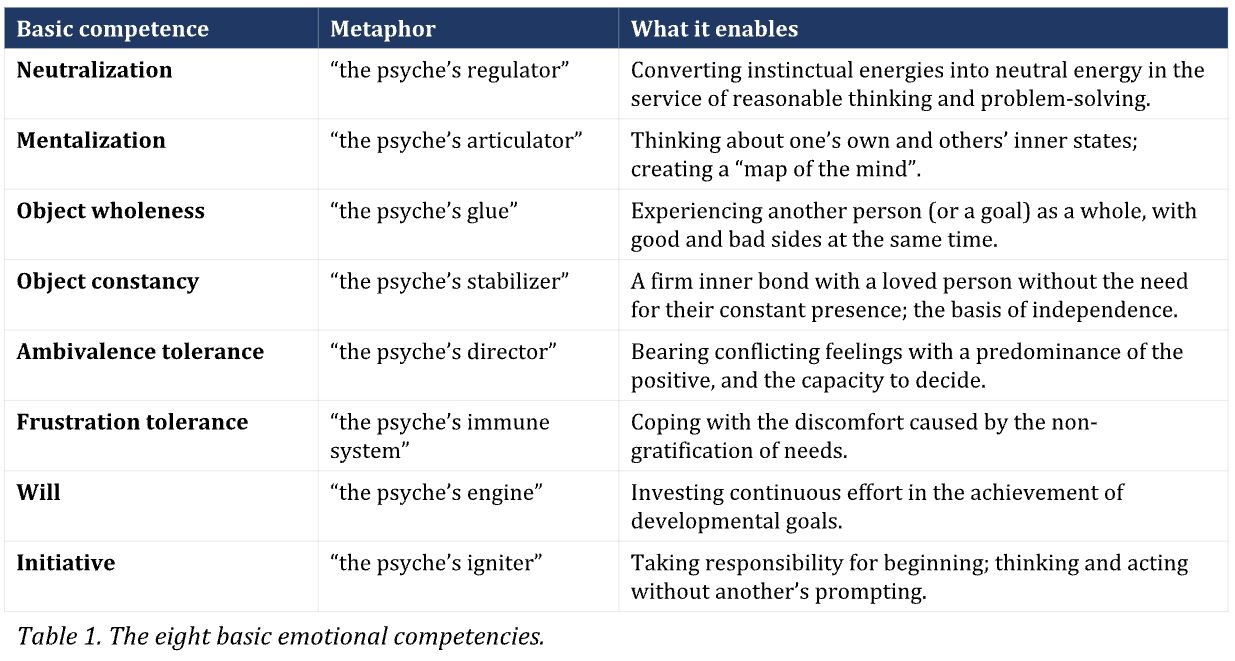
Basic emotional competencies. Eight mature ego capacities for processing and managing emotions, derived from the four psychoanalytic psychologies. Unlike defence mechanisms, the competencies do not distort reality in order to protect against anxiety; rather, they enable a realistic coping with emotional experience. An overview is given in Table 1.
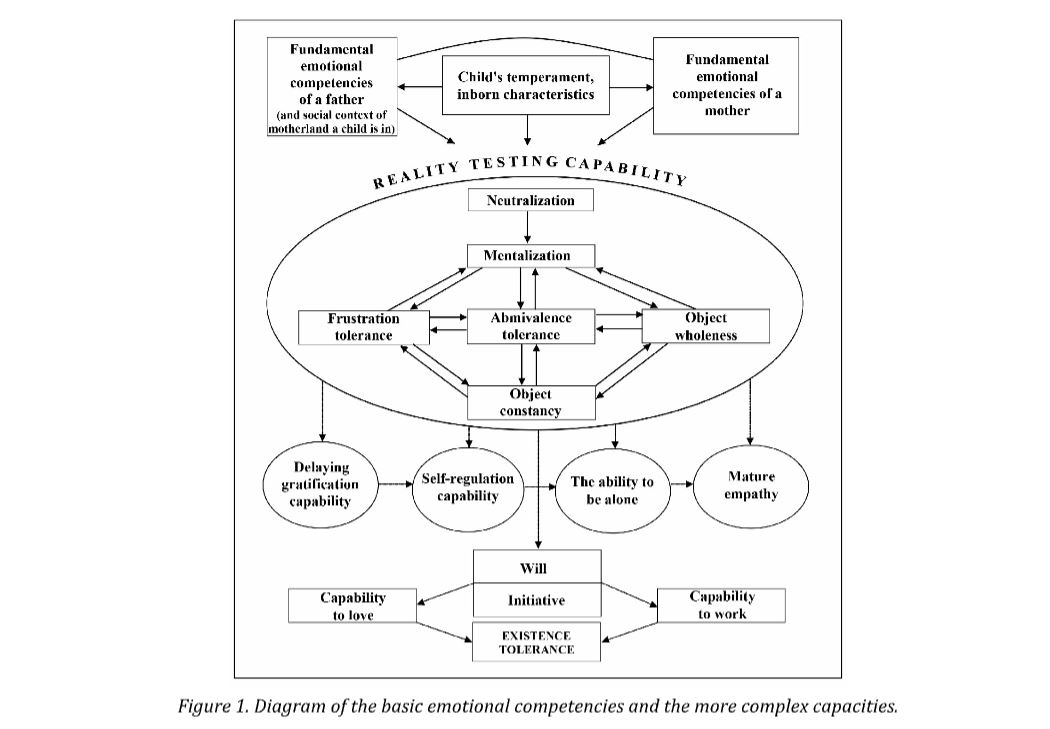
The compositional (hierarchical) model. The basic competencies are “lego bricks” from which more complex capacities are built (delay of gratification, self-regulation, the capacity to be alone, mature empathy), and out of these the most complex — the capacity to love and to work — with tolerance of existence at the top. This is clinically crucial: complex capacities cannot be developed directly (e.g., patience is composed of neutralization, object wholeness and object constancy, and frustration tolerance); one works on the basic bricks, because their deficit prevents the complex capacity from being well constructed. The relationship is shown on the diagram of capacities (Figure 1).
Counter-skill. The developmental “negative” of a competence: a once-adaptive “skill” (the best possible mode of adaptation in the conditions of growing up) that has been unconsciously retained even after the conditions changed. It is more complex than a single defence (it may encompass several defences and patterns) and represents the abuse of a defence for secondary gain, even when this is no longer necessary.
Secondary gain and the resistance of the system. Short-term benefits (avoidance of fear, gaining attention, relief from responsibility) that keep the system resistant to change; OLI IPP adds three further reasons for resistance — neurotic pride, fear of losing oneself, and moral justification.
Neurotic pride (Horney, 1950). In time the counter-skill ceases to be experienced as a weakness and begins to be experienced as a virtue of identity: the person takes pride in their “toughness” or, conversely, in their “gentleness”. Intervention on the counter-skill is therefore experienced as an attack on self-esteem, which intensifies resistance.
Fear of losing oneself. When it has existed long enough, the counter-skill becomes part of the self-image (“that is just how I am”). A client who begins to work it through fears that through therapy they will “lose themselves” and cease to be recognisable. This fear is not resolved by reassurance, but developmentally — as new competencies are established, the client gains the experience of still being themselves, only without the patterns that previously defined them.
Moral justification. The counter-skill often has the status of a moral position: the person is a “moral winner who is a real-life loser” — they suffer and lose, but experience this as proof of their rightness. To give up the counter-skill means, in that narrative, “to become like them”. Work with moral justification is therefore delicate: the client’s morality is not unmasked; rather, it is shown that morality is possible outside the structure that produces losses.
Hence the principle: “a pattern cannot be taken away from a person until something better is offered in its place”.
Two ethical pillars of mental health (truth; reciprocity rather than exploitation) and the concept of the “good person” as a developmental and ethical goal — an original contribution that links psychotherapy with education in the broadest sense.
Further conceptual contributions in more recent works:
“Vertical unconsciousness” and new defence mechanisms (Jovanović, 2024). Alongside the classical (horizontal) repression of content censored by the superego, a vertical organisation of the unconscious is described, together with its characteristic defensive manoeuvres by which the anxiety connected with ambivalence and contradiction is avoided — the simultaneous holding of incompatible contents outside integrated consciousness.
A typology of eight kinds of panic attack (Jovanović & Rudec, 2024). Anxiety and panic are not regarded as a single phenomenon but are classified according to the arrest in a particular basic competence: the underdevelopment of each of the eight competencies produces a panic/anxiety of its own kind, which enables targeted diagnosis and choice of intervention.
Transformations of the superego of the contemporary individual (Jovanović & Stevanović, 2024) — changes in the organisation and function of the superego in the contemporary social context.
4.2. Methodological contributions
Diagnostic tables of arrest. For each competence, indicators of arrest and of mature expression are defined on the behavioural, emotional, cognitive, and conative levels — enabling the recognition of deficits and the determination of the “zone of proximal development”.
A taxonomy of psychotherapeutic goals. Techniques (both psychodynamic and those from other approaches) are classified according to which competence, and in which developmental phase, they develop, cross-referenced with types of learning (conceptual/declarative, procedural, metacognitive). The choice of technique is thereby derived from the diagnosis, and integration acquires a clear principle (a systematic elaboration of techniques: Cmiljanović & Škorić, 2024).
Two planes of work (content and process) and the “transfer of functions”. On the process plane the therapist, as an “auxiliary ego”, transmits to the client mature ways of processing emotions through declarative and procedural learning; here too is “subsequent education” as a developmental frame.
Emotional accounting. A procedure by which the client consciously weighs the force that tends toward avoidance (of pain, risk, responsibility) against the force that tends toward development, so that resistance is moved from unconscious opposition into the space of conscious choice.
The PUNI model of psychodynamic logic (Needs–Beliefs–Ways–Outcomes) — a metamodel of clinical thinking with two cycles, the dysfunctional and the developmental (Figure 2). The diagram shows how the dysfunctional cycle (left) links an infantile-organised need (N), unrealistic beliefs (B), and counter-skills as ways (W) with negative outcomes (O) and secondary gain, which make it resistant to change. The “key dynamic” in the centre shows the dual function of outcomes (they frustrate the primary need while satisfying the secondary one). The developmental cycle (right) shows the same structure with a mature need, realistic beliefs, and emotional competencies as ways, leading to adaptive outcomes. Three arrows of “therapeutic change” lead from the left to the right cycle: transformation of needs, correction of beliefs, and replacement of counter-skills with emotional competencies. In the first phase of work the therapist “reads backwards” (from outcomes, through ways and beliefs, to the need) and resolves the dysfunctional cycle; in the second phase the developmental cycle is set in motion. The model distinguishes the universal, original need from the developmentally variable way of its desired satisfaction (organised maturely or infantilely).
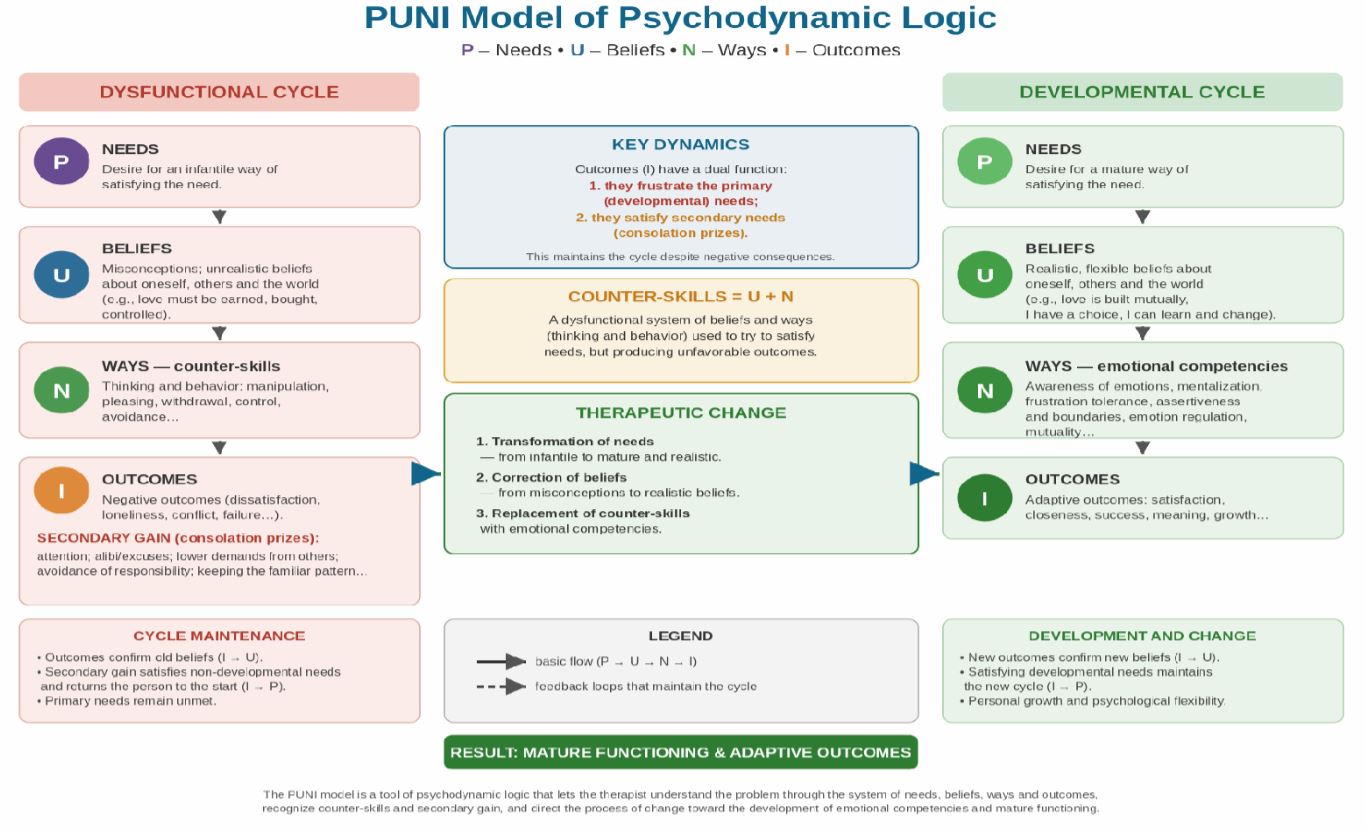
Figure 2. The PUNI model of psychodynamic logic — the dysfunctional and the developmental cycle.
5. Includes processes of verbal exchange, alongside an awareness of non-verbal sources of information and communication
Yes. Besides verbal work (reconstruction of the life story, interpretation, linking of patterns), the modality systematically attends to non-verbal and process sources as well: the manner of processing emotions during speech, bodily signals, affect regulation, and somatic countertransference as a source of data. Body-oriented and experiential techniques and self-regulation techniques are also used, as are self-help protocols, wherever they contribute to the development of a particular competence.
6. Offers a clear rationale for treatment/interventions facilitating constructive change of the factors provoking or maintaining illness or suffering
The factors that provoke and maintain suffering are developmental arrests in the competencies and the counter-skills that replace them, systems of dysfunctional beliefs, and secondary gain (together with neurotic pride, fear of losing oneself, and moral justification). The rationale for intervention follows from this: bringing the counter-skills and secondary gain into awareness through “emotional accounting”, the working-through of beliefs, and the gradual development of mature competencies as an alternative.
OLI IPP has an explicitly formulated theory of change (Jovanović & Jovanović, 2026, Insights 3). Change is not reduced to symptom reduction or to a change of behaviour, but is defined as the development of ego functions — the basic emotional competencies as the “operative carriers” of change — connected with work on transference, resistance, and the “transfer of functions”. The steps of change can be presented as follows:
(1) recognition of the recurring pattern and reconstruction of the dysfunctional system (PUNI “reading backwards”: from outcomes, through ways and beliefs, to the original need); (2) understanding the function of the counter-skills and of secondary gain and translating resistance into conscious choice (“emotional accounting”); (3) access to the original, developmentally grounded need (the emotionally most demanding step); (4) development of the deficient competence through the therapeutic relationship — the “transfer of functions” (declarative and procedural learning), subsequent education, and the “survival” of the therapist; (5) reorganisation of the system: counter-skills are replaced by mature competencies, beliefs are corrected, and the way of satisfying the need is organised more realistically — which yields new outcomes (markers of change); (6) the building of complex capacities — the capacity to love and to work — and tolerance of existence.
The reason for this particular approach, as opposed to a mere correction of symptoms, is developmental: sustainable change requires the development of capacities that render the symptom unnecessary — the principle that “a pattern cannot be taken away from a person until something better is offered in its place”.
7. Has clearly defined strategies enabling clients to develop a new organization of experience and behaviour
The strategies are linked into an operative chain from diagnosis to plan: the tables of arrest identify the deficient competence and determine the zone of proximal development; the PUNI model offers a strategy for understanding the system (see question 4); the taxonomy of goals selects techniques according to competence and phase. The strategies follow directly from the theory of the human being and of health/illness (question 3) and from the rationale for change and the steps of change (question 6): since the problem is a developmental arrest, the strategy is the development of competence, not the correction of the symptom. Change is achieved through work with the transference as a site of development, the “transfer of functions” (declarative and procedural learning), and subsequent education — so that the client reorganises perceptions, expectations, and behavioural patterns through the development of a mature competence, and not by the mere acquisition of techniques. Unlike approaches that correct a single belief or symptom, here the new organisation of experience is built “from the ground up” — by developing the basic competencies out of which the more complex capacities are assembled.
8. Is open to dialogue with other psychotherapy modalities about its field of theory and practice
Yes; openness is built into the nature of the modality and, as stated in the introduction, constitutes the ethical obligation of the integrative approach. The model of competencies is a shared language enabling exchange with other approaches — each technique is understood through the competence it develops. OLI IPP openly takes up and acknowledges the contributions of other schools (psychoanalysis, ego psychology, self psychology, object relations theory, Gestalt, transactional analysis, REBT, body psychotherapies, psychodrama), which is in keeping with the psychotherapy-integration movement (Norcross & Goldfried, 2005).
Openness is also built into the training itself: the curriculum shows that the techniques and concepts of other modalities are taught — Rogers’s non-directive counselling and client-centred therapy (the technique of reflection), cognitive and behavioural techniques, work on mentalization, and EMDR — with the concepts of other approaches being explicitly linked, for trainees, to OLI IPP competencies.
The clearest expression of this dialogue is a dedicated eight-month OLI IPP training intended for psychotherapists of other modalities, which the modality has been running for a number of years and through which a considerable number of therapists from different approaches have passed (family psychotherapy, Gestalt, transactional analysis, REBT, and others). Participants consistently report that an understanding of the basic emotional competencies enriches their picture of the human being and broadens their possibilities of assessment, treatment planning, and choice of techniques — and this within their home approach. This shows that OLI IPP is not a closed system but a framework usable by colleagues of other orientations and in dialogue with them.
Openness is further confirmed by: independent reviews by experts from other traditions (Jungian, process-oriented) upon admission to OPPL; joint appearances with representatives of other modalities (e.g., a round table of various modalities at the UPSKS congress in 2016; the participation of an educator with dual training — TA and OLI IPP — at the winter school of transactional analysis with the support of EATA, 2018); the presentation “Working with the ‘Shadow’ in the author’s O.L.I. method” at a conference of the Jungian modality of OPPL and the Faculty of Philosophy, MGU (2022), whereby OLI IPP was presented within the framework of another modality; and exchange within EAIPP and the journal Insights (Uvidi).
9. Has a way of methodically describing the chosen fields of study and the methods of treatment/intervention which can be used by other colleagues
Yes. The modality is described methodically and reproducibly: a theoretical-methodological manual and a series of books (Jovanović, 2013; 2025; 2026), clearly defined indicators of the development of each competence (tables of arrest and of mature expression on four levels), a taxonomy of psychotherapeutic goals, an operative metamodel of clinical thinking (PUNI), and an elaborated Framework of Competencies aligned with the EAP standard. The descriptions are given in terms applicable to colleagues from other methods as well, which makes the modality transferable and teachable. The model of competencies as a shared language contributes especially to this: since the constructs and techniques of different schools can be translated into the language of competencies (and vice versa), colleagues from other approaches can understand and apply OLI IPP descriptions, and OLI IPP can incorporate theirs — which in the training is operationalised through the linking of concepts of other modalities with OLI IPP concepts. That the knowledge is not bound exclusively to the author is attested by the fact that a wider circle of authors publishes and presents on OLI IPP (among them Rudec, Stevanović, S. Jovanović, Civrić, Pejović, Ovuka, Cvetković, Savić, Trbojević Jocić, Petrović, Grčić, Paunović, Stojković, Bogdanovska Toskić).
The methodical description is further operationalised through two manuals tied to the Framework of Competencies: a supervision manual (for trainees and supervisors) and a manual for trainees beginning work with clients — organised by phase of therapy, with the most frequent questions and errors, numerous examples from practice, and workbooks for mastering each individual competence from the Framework (with which participants are acquainted from the beginning of training). The knowledge is thereby rendered in a procedurally usable form that other colleagues can use.
The continuity and availability of the professional description is also supported by the publishing activity of the modality — the “Psychodynamics” book series, which brings together the author’s books and announced titles in preparation (working titles: “Psychodynamic Developmental Theories”, “Problems of Identity”, “Problems of Sexuality”, “Character Structures and Patterns”), ensuring systematic and ongoing publication in psychodynamics.
C. Research aspects
10. Is associated with information which is the result of conscious self-reflection, and critical reflection by other professionals within the approach
Yes, in both ways. The therapeutic effect rests above all on the client’s self-reflection (the development of mentalization, the bringing of patterns into awareness), and not only on the technical skill of the therapist.
At the same time, the modality is in constant contact with the critical reflection of other professionals within the approach. The centres gathered in EAIPP regularly hold professional meetings at which they exchange knowledge and innovations within the method, critically re-examine and evaluate the work, and contribute ideas about further development. For more than ten years an annual “Summer School” has been held in Slankamen (Serbia) as a place for the exchange of reflections and critical reflections on the theory and practice of the modality; there is also an Alumni group of trainees and therapists. To this are added the mandatory supervision and personal (training) analysis, the peer review of papers in the journal Insights (Uvidi), and regular presentations at professional gatherings. The journal Insights (three issues, 2024–2026) brings together papers by several authors from the OLI IPP circle and book reviews, so that the modality develops and corrects itself, rather than remaining a static system.
Self-reflection and quality control are institutionally built into the training itself: there is an electronic reading room with required and supplementary literature available throughout the training, as well as an electronic schedule with literature and tasks for each module. After each module trainees are given questions for checking and reflection, and each module is evaluated by the participants themselves — which ensures systematic feedback and continuous improvement of the programme on the basis of the critical reflection of those who take part in it.
11. Offers new knowledge, which is differentiated and distinctive, in the domain of psychotherapy
While question 4 describes the specific methods of the approach itself, here the focus is on the contribution to the discipline of psychotherapy as a whole — the new knowledge that OLI IPP brings into the field. The distinctiveness lies not in individual techniques but in the way it organises knowledge, and that way offers several contributions to the wider profession:
First, a contribution to the field of psychotherapy integration: an operative and teachable model of mature ego capacities (competencies) as a substantive principle of integration — an alternative both to mere eclecticism and to reliance on “common factors” alone. Second, the concept of the counter-skill as a conceptual bridge between psychoanalytic defence theory and contemporary skill-/competence-based approaches. Third, a trans-theoretical taxonomy that links the techniques of different schools to developmental goals, usable beyond the OLI IPP framework as well. Fourth, the PUNI model as a teachable metamodel of clinical (psychodynamic) thinking, applicable in other psychodynamic approaches too. Fifth, an ethical-developmental reframing of psychotherapy (psychotherapy as education; the concept of the “good person”), which returns to the discipline an explicit ethical dimension of maturity.
That the profession recognises this novelty as distinctive is attested by the admission of OLI IPP to OPPL as a separate authorial modality, its inclusion in the register of methods (modalities) recognised in the Russian Federation, and presentations at international gatherings (e.g., the 23rd World Congress of Psychiatry, WPA, Vienna, 2023).
12. Is capable of being integrated with other approaches considered to be part of scientific psychotherapy so that it can be seen to share with them areas of common ground
Yes; this is a defining feature and the place of strongest scientific support, on two levels. At the level of general mechanisms, a successful outcome is contributed to by common factors, above all the therapeutic alliance (Wampold & Imel, 2015; Lambert & Barley, 2001) — and OLI IPP works explicitly on the relationship; comparative studies also show the comparability of outcomes of well-founded approaches (Smith & Glass, 1977; Luborsky et al., 1975). As a psychoanalytically grounded approach, OLI IPP also relies on the evidence for the efficacy of psychodynamic psychotherapy (Shedler, 2010; Leichsenring & Rabung, 2008; Leichsenring et al., 2023).
At the level of specific mechanisms, the model of competencies is a common ground around which the knowledge of diverse, scientifically recognised schools can be organised, so that the results of their research constitute convergent (component) evidence for OLI IPP as well:
mentalization — mentalization-based treatment, MBT (Bateman & Fonagy, 2009); frustration tolerance — REBT and DBT (David et al., 2018); object wholeness — transference-focused psychotherapy, TFP (Doering et al., 2010); ambivalence tolerance — motivational interviewing (Rubak et al., 2005); initiative — behavioural activation (Cuijpers et al., 2007); neutralization/affect regulation — DBT regulation skills (Linehan, 1991); object constancy and will — attachment, reflective functioning, and self-determination theory (Fonagy et al., 2002; Ryan & Deci, 2017). This evidence confirms the components and mechanisms that OLI IPP integrates; it does not replace an outcome study of OLI IPP as a whole, but, in keeping with the pluralism of evidence, it constitutes a firm basis of scientific grounding.
13. Describes and displays a coherent strategy to understanding human problems, and an explicit relation between methods of treatment/intervention and results
Yes. The strategy of understanding is developmental: the problem is a developmental arrest in which a mature competence has been replaced by a counter-skill, and suffering is the consequence of that arrest and of secondary gain. From this understanding the method follows explicitly: diagnosis identifies the arrested competence and determines the zone of proximal development; the PUNI model reconstructs the dysfunctional system; the taxonomy of goals selects techniques for developing precisely that competence; the developmental cycle replaces the counter-skill with a mature competence. The relation to results is explicit: the expected outcome is a developed competence and, consequently, different symptomatic and relational patterns. The modality distinguishes apparent change (a quick easing of symptoms without working through deeper levels) from genuine change, which is visible in outcomes but is produced through long-term developmental work.
14. Has theories of normal and problematic human behaviour which are explicitly related to effective methods of diagnosis/assessment and treatment/intervention
Yes, through a unified framework. Normal behaviour is the development of competencies and the accomplishment of developmental tasks; problematic behaviour is developmental arrest and the counter-skill — which is linked with generally accepted conceptions of psychopathology (defence mechanisms, personality structure, affect regulation).
As regards diagnosis, OLI IPP develops its own instruments (MOP-OLI — Petrović, Jovanović & Trbojević, 2015; a scale for the eight competencies under development), but also uses existing, validated instruments for related constructs: for mentalization — the Reflective Functioning Questionnaire (RFQ-8; Fonagy et al., 2016) and the MASC; for neutralization and affect regulation — the DERS (Gratz & Roemer, 2004) and the ERQ (Gross & John, 2003); for object wholeness/constancy and personality structure — the IPO/STIPO and the Bell Object Relations Inventory (BORRTI), and for attachment the ECR and the Adult Attachment Interview; for ambivalence tolerance (splitting) — the Splitting Index (Gould et al., 1996); for frustration tolerance — the Frustration Discomfort Scale (Harrington, 2005) and the Distress Tolerance Scale (Simons & Gaher, 2005); for initiative and will — the BADS and scales of satisfaction of basic psychological needs; and general outcome measures — the IIP, OQ-45, CORE-OM. The same developmental framework guides diagnosis, intervention, and research alike.
The development of a proprietary instrument — the OLI IPP Test of Emotional Competencies has moved from the stage of construction to the stage of empirical verification. A pilot study was conducted on a sample of 222 participants, with a version of the questionnaire comprising 189 items distributed across eight theoretically derived factors (object wholeness, object constancy, mentalization, neutralization, ambivalence tolerance, frustration tolerance, will, and initiative). The results confirm the psychometric soundness of the instrument: all subscales have high internal consistency (Cronbach’s α in the range .81–.94), and the inter-correlations of the factor scores (.55–.84) correspond to the theoretically expected relatedness of the competencies.
Of particular importance is the finding on the hierarchical structure of the model: a second-order analysis showed that the first principal component explains 64.4% of the variance among the factors, and the bifactor indices (ω_h = .89; ECV = .58) show that the instrument primarily measures one dominant general construct, while the eight subscales retain clinically informative specific variance (from 17% for frustration tolerance to 57% for mentalization). The very theoretical architecture of OLI IPP is thereby empirically corroborated — the existence of a general capacity superordinate to the capacities to love and to work, operationalised as psychological maturity. The pilot also identified specific items for revision and served as the basis for the design of a large validation study (see question 15). Thus the diagnostics of OLI IPP no longer rest only on borrowed instruments, but also on a proprietary, measurable operationalisation of the model (Miletić, 2025).
15. Has investigative procedures which are defined well enough to indicate possibilities of research
Yes. OLI IPP possesses its own emerging empirical base — the psychometric examination of the MOP-OLI questionnaire (Petrović, Jovanović & Trbojević, 2015) and a scale for measuring the eight competencies under development — together with academic research capacity in the team (associates with doctorates and a series of peer-reviewed papers in indexed journals; e.g., the monograph on lifelong development, Petrović & Trbojević Jocić, 2025) and more than two decades of clinical application with accredited programmes.
Its proprietary and practice-based evidential base also includes: two decades of clinical practice; accredited applied programmes (teacher training under the Ministry of Education of the Republic of Serbia; psychodynamic coaching accredited with the EMCC; programmes in sport with the Olympic Committee of Serbia); independent expert reviews upon admission to international bodies (OPPL, EKPP); and international presentations (e.g., the 23rd World Congress of Psychiatry, WPA, Vienna, 2023).
Since the competencies are operationalised and measurable, clear and feasible lines of research open up: psychometric validation of the proprietary instruments (factor structure, reliability, convergent validity in relation to the measures listed above); naturalistic cohort outcome studies across the international training network, using validated measures (CORE-OM, OQ-45, PHQ-9/GAD-7, IIP, reflective-functioning questionnaires); process evaluation; and testing of the efficacy of self-help protocols. The procedures are defined well enough to permit independent, external verification as well.
That these procedures are not merely possible in principle is shown by the already-conducted pilot study of the OLI IPP Test of Emotional Competencies (N = 222; see question 14), on the basis of which a precise plan for a large validation study has been defined: collection of a sample of at least 900 participants (a satisfactory ratio of participants to variables); exploratory factor analysis with oblimin rotation for an empirical revision of the assignment of individual items; confirmatory factor analysis of three competing models (single-factor, eight correlated factors, bifactor) on an independent subsample or through split-half validation; a test of measurement invariance by sex and age group; and the establishment of preliminary norms for clinical interpretation.
In addition to validating the instrument, its inclusion in a broader cohort study of psychotherapy outcomes is planned, together with internationally recognised measures — thereby securing both the convergent and incremental validity of the instrument and the collection of data on the efficacy of the OLI IPP approach. The existence of a conducted pilot with clearly operationalised hypotheses and measurable success criteria shows that the modality not only indicates possibilities of research but also has an active, quantitatively grounded research programme under way.
Appendix: The official EAP “15 questions on scientific validity” (original text)
Phrase that precedes each question: “Please provide evidence that the modality:”
- Has clearly defined areas of enquiry, application, research, and practice.
- Has demonstrated its claim to knowledge and competence within its field tradition of diagnosis/assessment and of treatment/intervention.
- Has a clear and self-consistent theory of the human being, of the therapeutic relationship, and of health and illness.
- Has methods specific to the approach which generate developments in the theory of psychotherapy, demonstrate new aspects in the understanding of human nature, and lead to ways of treatment/intervention.
- Includes processes of verbal exchange, alongside an awareness of non-verbal sources of information and communication.
- Offers a clear rationale for treatment/interventions facilitating constructive change of the factors provoking or maintaining illness or suffering.
- Has clearly defined strategies enabling clients to develop a new organization of experience and behaviour.
- Is open to dialogue with other psychotherapy modalities about its field of theory and practice.
- Has a way of methodically describing the chosen fields of study and the methods of treatment/intervention which can be used by other colleagues.
- Is associated with information which is the result of conscious self reflection, and critical reflection by other professionals within the approach.
- Offers new knowledge, which is differentiated and distinctive, in the domain of psychotherapy.
- Is capable of being integrated with other approaches considered to be part of scientific psychotherapy so that it can be seen to share with them areas of common ground.
- Describes and displays a coherent strategy to understanding human problems, and an explicit relation between methods of treatment/intervention and results.
- Has theories of normal and problematic human behaviour which are explicitly related to effective methods of diagnosis/assessment and treatment/intervention.
- Has investigative procedures which are defined well enough to indicate possibilities of research.
References
Bateman, A. & Fonagy, P. (2009). Randomized controlled trial of outpatient MBT versus structured clinical management for BPD. American Journal of Psychiatry, 166(12), 1355–1364.
Cmiljanović, O. & Škorić, J. (2024). Psihoterapijske tehnike za razvoj bazičnih emocionalnih kompetencija [Psychotherapeutic techniques for developing basic emotional competencies]. Novi Sad.
Cuijpers, P., van Straten, A. & Warmerdam, L. (2007). Behavioral activation treatments of depression: a meta-analysis. Clinical Psychology Review, 27(3), 318–326.
David, D. et al. (2018). 50 years of rational-emotive and cognitive-behavioral therapy: a systematic review and meta-analysis. Journal of Clinical Psychology, 74(3), 304–318.
Doering, S. et al. (2010). Transference-focused psychotherapy v. treatment by community psychotherapists for BPD: randomised controlled trial. British Journal of Psychiatry, 196(5), 389–395.
Erikson, E. H. (1959). Identity and the Life Cycle. Psychological Issues, 1, 1–171.
Fonagy, P., Gergely, G., Jurist, E. L. & Target, M. (2002). Affect Regulation, Mentalization, and the Development of the Self. New York: Other Press.
Fonagy, P. et al. (2016). Development and validation of a self-report measure of mentalizing: The Reflective Functioning Questionnaire. PLOS ONE, 11(7), e0158678.
Gratz, K. L. & Roemer, L. (2004). The DERS. Journal of Psychopathology and Behavioral Assessment, 26(1), 41–54.
Gross, J. J. & John, O. P. (2003). Individual differences in two emotion regulation processes (ERQ). Journal of Personality and Social Psychology, 85(2), 348–362.
Gould, J. R., Prentice, N. M. & Ainslie, R. C. (1996). The Splitting Index. Journal of Personality Assessment, 66(2), 414–430.
Harrington, N. (2005). The Frustration Discomfort Scale. Clinical Psychology & Psychotherapy, 12(5), 374–387.
Jovanović, N. (2013). Sposobnost za ljubav i rad [The Capacity to Love and to Work]: OLI Integrative Psychodynamic Psychotherapy. Belgrade: Beoknjiga.
Jovanović, N. (2024). Vertical Unconsciousness and New Defense Mechanisms. Insights (Uvidi) – Journal of the EAIPP, 1, 49–74.
Jovanović, N. & Rudec, M. (2024). Eight Types of Panic Attacks (Anxiety Disorder in OLI IPP). Insights (Uvidi) – Journal of the EAIPP, 1, 1–28.
Jovanović, N. & Stevanović, A. (2024). Transformations of the Superego in Contemporary Individuals. Insights (Uvidi) – Journal of the EAIPP, 1, 75–103.
Jovanović, N. (2025). Development of Basic Emotional Competencies in OLI Integrative Psychodynamic Psychotherapy. Amazon Kindle Direct Publishing.
Jovanović, N. & Jovanović, S. (2026). Otpor i transfer u psihoanalizi i psihoterapiji [Resistance and Transference in Psychoanalysis and Psychotherapy]. Belgrade: OLI Centar.
Jovanović, N. & Jovanović, S. (2026, in press). Theory of Change in OLI Integrative Psychodynamic Psychotherapy. Insights (Uvidi) – Journal of the EAIPP, 3.
Jovanović, N. (2022). Working with the “Shadow” in the author’s O.L.I. method. 4th Conference of the “Jungian Analysis” modality (OPPL) and the Faculty of Philosophy, MGU, 23 June 2022.
Lambert, M. J. & Barley, D. E. (2001). Research summary on the therapeutic relationship and psychotherapy outcome. Psychotherapy, 38(4), 357–361.
Laska, K. M., Gurman, A. S. & Wampold, B. E. (2014). Expanding the lens of evidence-based practice in psychotherapy. Psychotherapy, 51(4), 467–481.
Leichsenring, F. & Rabung, S. (2008). Effectiveness of long-term psychodynamic psychotherapy: a meta-analysis. JAMA, 300(13), 1551–1565.
Leichsenring, F. et al. (2023). The status of psychodynamic psychotherapy as an empirically supported treatment — an umbrella review. World Psychiatry, 22(2).
Linehan, M. M. (1991). Cognitive-Behavioral Treatment of Borderline Personality Disorder. New York: Guilford Press.
Luborsky, L., Singer, B. & Luborsky, L. (1975). Comparative studies of psychotherapies. Archives of General Psychiatry, 32(8), 995–1008.
Miletić, B. (2025). Pilot validation of the OLI IPP Test of Emotional Competencies (internal research report). OLI Centar.
Norcross, J. C. & Goldfried, M. R. (Eds.) (2005). Handbook of Psychotherapy Integration (2nd ed.). New York: Oxford University Press.
Petrović, J., Jovanović, N. & Trbojević, J. (2015). Psychometric properties and factor structure of the MOP-OLI questionnaire of motivational (driving) forces. First European Conference on Psychological Counselling, Petnica.
Petrović, J. & Trbojević Jocić, J. (2025). Dodati život godinama [Adding Life to Years]: Development in Adulthood and Old Age. Belgrade: Sinapsa edicije.
Rubak, S. et al. (2005). Motivational interviewing: a systematic review and meta-analysis. British Journal of General Practice, 55(513), 305–312.
Ryan, R. M. & Deci, E. L. (2017). Self-Determination Theory. New York: Guilford Press.
Shedler, J. (2010). The efficacy of psychodynamic psychotherapy. American Psychologist, 65(2), 98–109.
Simons, J. S. & Gaher, R. M. (2005). The Distress Tolerance Scale. Motivation and Emotion, 29(2), 83–102.
Smith, M. L. & Glass, G. V. (1977). Meta-analysis of psychotherapy outcome studies. American Psychologist, 32(9), 752–760.
Wampold, B. E. & Imel, Z. E. (2015). The Great Psychotherapy Debate (2nd ed.). New York: Routledge.
Winnicott, D. W. (1969). The use of an object. International Journal of Psycho-Analysis, 50, 711–716.